encryptolink

Accessorizing Computers - What Comes Out of the Box is a Really Just a Starter Kit

Accessorizing Computers What Comes Out of the Box is a Really Just a Starter Kit
Accessorizing Computers, 
What Comes Out of the Box is a Really Just a Starter Kit - Yesterday, we spent about three hours trying to convince a client of ours that brand new computers just don't come equipped with the all things that most computers need in a PC. We tried to convince him that a fully functional computer is one that is personalized with specially selected hardware and software accessories - and that the computer purchased at the store doesn't come with these things. Unfortunately, all of our convincing was to our avail. Our client insisted that he should never need more than what came with his boxed product and that we were just trying "bilk" more money out of him.

As computer consultants, it's our job and mission to make sure our clients are 100% satisfied when they walk out our offices. But our job is unnecessarily made harder when people don't take the time to learn about computer accessories and familiarize themselves with the limitations of store-bought computers. Hopefully by the time you finish reading this article, you'll understand the lesson that we were trying to teach our client: "What comes out of the box is really just a starter kit."

The typical computer package comes with a CPU unit, keyboard, mouse, and speaker set. That may be just fine for some, but most people require more than that especially in today's "connected" society. Today's users require full multimedia capabilities, a wide range of graphics tools, and accommodations for the various portables we now enjoy. These extras aren't included with "what comes out of the box," and the only way to get them is to accessorize.

To illustrate the importance of accessorizing, we like to use the "plain dough" analogy. Let's say that a brand new computer is a batch of plain dough - waiting to be flavored and baked into something useful. If we want to use this dough to make a delicious batch of chocolate chip cookies, we would need to "accessorize" this dough with chocolate chips and a little brown sugar. If we want to use this dough into in a warm loaf of sesame seed bread on the other hand, we'd need to "accessorize" the dough with yeast and sesame seeds.

Like "plain dough," the brand new computer isn't very useful by itself. It needs accessorizing.

Depending on what's needed, accessorizing doesn't need to be expensive.  In fact, you can get away with paying a minimal amount for extra software and hardware if these accessories are for children. It's when these accessories are work requirements or when they're needed to produce works of quality for any other reason that they can become rather expensive. And this expense applies to microphones, digital cameras, PDAs, scanners, video cams, and more.

Regardless of cost, it's important to understand that accessories can become "necessities," and that the best time to get them is the moment you buy a new computer. Waiting too long to accessorize can cause more problems than necessary because while you wait, manufacturers continuously develop new technologies - technologies that your computer won't be able to accommodate in the future. Once you're ready to accessorize, the new products on the market are too advanced for your computer and they just won't work. This is a typical problem experienced by those who want to use hardware designed for Windows Vista on a Windows XP or Windows 2000 machine.

Buying a Computer What To Do And Why

Buying a Computer What To Do And Why
Buying a Computer What To Do And Why - It isn't fair, but buying a computer is just plain easier for some than it is for others. Those who've purchased and used a computer in the past already have an idea of what they need in a new computer. But those who are new to the computer world could get lost in the myriad of choices available.

The short answer to "What should I buy?" is "The best." Of course that answer is extremely subjective because "the best" to one person is certainly different to another. Our definition of "the best" is the fastest and the biggest, but even that leaves the computer newbie confused. Here's a quick rundown of what the computer novice should do and why.
1. Buy a computer that includes basic peripherals. Every computer can be broken down into four major components: CPU unit, monitor, keyboard, and mouse. For the novice, it's best to buy a computer that has all of these components included so that when it's taken home, assembling the computer is a simple matter of plugging things in where they belong. Save the individual purchases of these components for those who have more experience.

2. Decide what you'll use the computer for. If you want to use your computer for cruising the web, sending email, or performing simple word-processing or spreadsheet tasks, a computer with the basic components that we just described should suffice. If you want to use a computer to help with a career in multimedia however, you're going to need to accessorize your system with a scanner, printer, digital camera, tablet, or digicam for example. If you want a computer to help with a career in music, you will need a quality microphone and set of speakers. 

3. Create a budget and stick to it. How much can you afford to spend on a new computer? Although the prices of computers are decreasing, they can still create a hefty expense especially if you need additional peripherals described above. In addition, you'll need to figure in costs for maintenance, servicing, and insuring.

4. Start comparison shopping and look for the "fastest and biggest." By "fastest and biggest," we mean the computer with the fastest processor, the fastest modem, the biggest memory, and the biggest hard drive capacity. Even if you think that you'll never need the amount of speed or space available on the market today, it's important to have in the event that you truly do need that much in the future. Having such a large reserve will cut down on costs when the time comes to upgrade for more than what you may settle for in a computer that offers less.

5. Stick with the better-known brands. Venturing off the beaten path with lessor-known brands is again, an adventure for those who have more experience with computers. Although those better-known brands may be a tad bit more expensive, the computer novice will appreciate the comfort in purchasing a computer from a business that has a long record of building quality products, and that has the funds available for fulfilling returns, trades, servicing, and warranties.

6. Select a store. Having an idea of what you want in a computer and what kind of computer that you want, your only task left is to select the place in which you want to buy it. There are a number of places available including computer store outlets, online stores, auction sites, used computer stores, or your friendly neighborhood yard sale. For the computer novice, we recommend buying a computer from a physical store. In  a physical store, you have the opportunity to see the computer of interest in person and ask questions. New computer buyers also have access to store warranties, returns, trades, and services. 

These suggestions should give the computer newbie a great start in selecting a quality computer for the first time and they apply to either Windows computers or Apple Macintosh computers. After making these decisions and finally selecting one that fits your needs, you can then venture into the fascinating world of software - a world that is just as grand as the world of hardware!

A Few Common Computer Errors (And What They Mean)

A Few Common Computer Errors (And What They Mean)

A Few Common Computer Errors (And What They Mean)

A Few Common Computer Errors (And What They Mean) - Computer errors can pop up when least expected, they can cause the entire system to suddenly shut down, and they can inadvertently corrupt data to the point where it can't be deciphered. Although they can't always be avoided, it's important to remember that computer errors can be corrected. The key is to understand what computer errors are, understand what they mean when they show up, and understand how to minimize their occurrence in the first place.

Basically, computer errors are the result of a number of things that may or may not have anything to do with the way the computer is used. They "operate" whenever there's a conflict among commands. Remember that computers essentially run off of a series of commands and it's usually a smooth process. But when one command conflicts with another command - or when one command asks for a process or information that isn't available, the computer returns results that aren't useable. That's an error.

A prime example of this kind of error is when users attempt to use software that isn't applicable for their system. Almost all software accompanies a list of system requirements which dictates what a computer needs to have in order for the software to work properly. To minimize errors of this sort, always verify that your computer has the required components. A project management program that you're interested in may require a specific operating system, like Windows XP for example. And although this program may install just fine on a Windows 98 machine, it will generate a multitude of errors once its started. 

Insufficient memory will cause errors as well. That's why software programs include minimum memory requirements. A program that needs 14MB of memory will generate errors on a computer that only has 4MB of memory if it runs at all. The same goes for disk space, monitor color depth and resolution. In these situations, problems occur the moment that a piece of software attempts to access the things (hardware, memory, space, resolution, etc.) that it cannot find.

Because some programs share common files, errors can also occur when these shared files are not up to date. For instance, let's say that Program A is already installed on a computer and it's working just fine. Then let's say that the user of that computer downloads and installs Program B. Program B uses a file that Program A installed much earlier, but when Program B is run, errors popup. Those errors are the result of Program B attempting to use an outdated (shared) file that was installed by Program A. In order to fix that problem, the user would have to download an updated version of the shared file (which to say the least - is not an easy thing to find or do).

Sometimes, errors occur because a system doesn't have the required drivers or the drivers that are on the system are the incorrect version. Both errors in these cases can be resolved by updating the computer on a regular basis. Microsoft provides a section on its website that can automatically update a computer online and it does this at no cost in an effort to reduce errors like this. Always try to keep your computer updated so that should a program share a file, it will share a file that has been updated on hundreds of thousands of computers, like yours.

This article doesn't even begin to cover the entire gamut of computer errors - but additional information regarding how to get help with a computer issue (including computer errors) can be found in our article titled, "Computer Help" no matter what the problem is.

Basic GUI Terminology - Knowing What You're Working With Helps Technicians

Basic GUI Terminology Knowing What You're Working With Helps Technicians
Basic GUI Terminology, Knowing What You're Working With Helps Technicians - Getting help with your computer software can be easier when you know the correct terms to use. One of the biggest problems that new computer users have with technical support is not knowing how to correctly describe the problem that they're having. And it isn't fair to expect a tech support person to automatically know what a "thing-a-ma-jingy," or "whatcha-ma-call-it" is.

The following describes the correct names for common components of software so that when you experience a problem, you can effectively describe an issue that you're having and a technician can readily resolve it.

User interface - this is the visual design of a program. It may contain squares, boxes, words, icons, and buttons. If you're experiencing insufficient memory for example, you might see black rectangles across the user interface of your software programs.

Title bar - this is the top-most part of a program that displays its own name or it may describe the contents displayed in another part of the interface. If a program is incorrectly coded, you may see a wrong description in this part of its interface.

Menu bar - this part of a program displays menu items and menu options. Some of the most common parts of a menu bar grants access to File commands, Open commands, Save commands, and Print commands. An example of an error in this part of an interface would be if an option was missing or grayed out (lighter in color).

Tool bar - this part of a program displays small icons across the top which represent tools. Clicking an icon will open a tool or process a command that might also exist on a program's menu bar. Problems in this part of an interface are uncommon, however if you find yourself repeatedly clicking an icon with no results, you can correctly describe the problem by referring to the toolbar. 

Minimize, Restore, and Exit buttons - these three buttons are usually located on the right-most upper part of a program's interface and each allow you to minimize a program's screen, restore it to its original size, or shut down the program completely.

Scroll bar - this convenient tool allows users to move data up and down the computer screen. 

Status bar - this part of a program is located at the bottom-most part of its interface, and it usually displays small messages that indicate the progress of a command or task. If programmed incorrectly, an application might display the wrong information in this area.

Context menu - like the menu bar, a context menu displays when a user right-clicks on something. It displays commands just like what you see on a File menu or a Help menu.

Input box - input boxes are usually small rectangles that allow you to type data into a simple interfaces like a webpage or browser window. If you find that you can't type information into one of these, you can effectively resolve the issue with a technician by calling it an input box, rather than a "white rectangle," or "place to put in text."

Button - buttons perform a command after a user clicks them with a mouse. Problems occur when the text of a button is grayed out or if it doesn't appear to sink into the screen when clicked.

Check box - a check box is a small box that allows a user to indicate several choices among many. When clicked, a small "x" displays inside a box. Similar to the check box, a radio button allows a user to indicate a single choice among many. Problems with radio buttons and check boxes occur when a user makes one choice, but the interface reacts as if the user made many choices (or none at all). When describing a problem to a technician, be sure to indicate whether the problem occurs with a check box or a radio box. Computer novices mistakenly interchange the names of both of these controls.

10 PASSIVE INCOME IDEAS TO START TODAY TO MAKE MONEY

10 PASSIVE INCOME IDEAS TO START TODAY TO MAKE MONEY

10 PASSIVE INCOME IDEAS TO START TODAY TO MAKE MONEY - Since starting my business I have been able to make money every single month and most of the income that I make is passive. Passive income is money that is earned every day with little daily effort from the individual. Passive income can be the result of different products or programs that a person already have set in place to sell. For example, if you create a course and it makes sells while you are out shopping or sleeping it would be considered as a passive income product.

A lot of people call passive income “Money that you can make while you sleep” and while this is true it can take a lot of dedication to get this format set up in the beginning. This post will share 10 passive income ideas to make money while on the go or while you sleep.

1. START A BLOG

One of the best ways to make passive income is to start a blog. You can make passive income from a blog in a lot of different ways such as affiliate marketing, ad revenue and creating your own products. One of the best ways to make passive income from a blog is selling your own products such as Ebooks, courses, printables, guides and more.  Below are some tips to take before creating products for your audience.

Before Creating New Products Try This:

Know and find your audience: One of the first mistakes I did when I started my business was not finding my main audience. By finding your tribe first it will help you serve their needs better. It will also help you write content that your audience wants to read and create products that your audience will buy.

 Find out what your audience needs and create solutions for their problems: Before creating any new product I always send out surveys to my audience to see what they need help on and to find out the problems they have. After that, I create products that can help solve their pain points and the struggles they are facing.

 Have a marketing plan: After creating a product for your audience make sure to have a marketing plan in place. A lot of people have great products but they don’t secure a good marketing plan to market the product. Think about where your audience hangs out and which social media platforms would be best for you to promote your product. 

 2. WRITE AN E-BOOK

If you have an idea that can help your audience you can write an Ebook. Ebooks normally focus on some of the problems that your audience may have in writing form. Your main focus is to help your audience solve a problem in the book and show them how to achieve the solution. 

When developing an Ebook here are some things to think about:
  • The topic
  • The book layout (font size, images, etc)
  • Your book cover
  • How you will sell the product
  • Your book landing page (sale page)

Platforms To Create Ebooks
  • Canva
  • Google Doc
  • Apple Pages

Once your Ebook is completed and edited you can import it as a PDF and upload it on your place of delivery. 

Places To Deliver Ebooks To Your Audience
  • Sendowl 
  • SamCart
  • Gumroad
  • PulleyApp

If you need ideas about how to design your Ebook you can reach out to designers on Fiverr to create your Ebook covers and pages. 

3. CREATE A  COURSE

Another way to make passive income is from developing courses. Courses are normally a little be more in detailed than Ebooks and can be more hands-on depending on your product. Before I create any product such as courses I make sure to survey my audience to see what they need at that moment. I currently use Typeform and Survey Monkey to send out emails with surveys and polls to see what I should focus my attention on. 

For example, I recently sent my audience a survey and found out that my audience wanted a set of budget templates to help them create a budget with a breeze and to save money faster. After finding out what my audience wanted the most I went into the creation lab and started designing a set of budget templates that have actually helped me so much with staying on budget as well. I will be launching them on July 1st!

Where To Sell Your Course:
  • Teachable
  • Thinkific
  • Kajabi
  • Course craft
  • Podia

Places To Record Videos For Your Course:
  • Loom
  • Ecamm
  • Screencast -O- Matic
  • Screen Flow

4. SET UP AN ETSY SHOP

If you love selling handmade crafts or digital products setting up an Etsy shop might be a great way for you to earn passive income. I did an interview last year with an Etsy shop owner and she earns six-figures a year with her Etsy shop. In the interview, she shared how to grow an Etsy business and make money from home.

If you are looking for more information on how to get started with an Etsy shop you can check out Facebook groups. A lot of Facebook have resources and you can ask other shop owners direct questions on how to get started. If you are looking for a great Etsy group on Facebook check out the Handmade JourneyFacebook group.

5. START A YOUTUBE CHANNEL

YouTube is one of the largest search engines out right now and another great way to make passive income. From my research, there are a lot of different Influencers that make great passive income right from the platform. One family that stood out to me was Ryan and his family and their YouTube channel, “Ryan Toy Review“. Just last year alone Ryan and his family made $11 million dollars from their videos of Ryan playing with toys on YouTube.

Now that’s not the norm but a lot of other Influencers make at least an extra $500 to $1000 each month with their YouTube videos. One of the best ways to make passive income from YouTube is through their Ad program. They have a program called “YouTube Partner Program” where you can monetize your channel. In order to get accepted into the program, you need 1000 subscribers and 4,000 watch hours over the past 12 months. Your videos will also be monitored very closely to make sure the content isn’t inappropriate. Before this year any person could get into the program but Google which is now YouTube owners announced new standards to get into the program.

6. RENT OUT YOUR GUESTHOUSE OR ROOM

Another great way to make money each month is by renting out a room in your home or guesthouse through Airbnb. Airbnb is the alternative to hotels.Airbnb hosts share their spaces in 190 countries and more than 34,000 cities.  Currently, there are a lot of people who rent out their guesthouses on Airbnb and make an additional $3,000 in passive income each month. 

If you are open and have space in your home this is a great way to make extra money every single month. 

Tips For Success on Airbnb:
  • Looks for guests who have positive reviews from other hosts.
  • Don’t put anything with huge value in the place you are renting out.
  • Be totally honest with your guest(s).
  • Make sure to offer great customer service to your guest(s).

7.  MAKE SWAGBUCKS YOUR SEARCH ENGINE & REFER YOUR FRIENDS

I absolutely love Swagbucks and each month I make between $150-$200 extra just from referring my friends to the site and having it as my search engine. If you are looking for a legit survey site this is the one for you.  If you are looking to make the most money on this platform I always suggest to my readers to refer the site to their friends, family and even their blog readers. 

I also suggest that they use the platform as a search engine on one of your computers at home. When you make Swagbucks your search engine every time you search for something on the search engine you get reward points that can turn into Swagbucks points. Once you get to a certain amount of points you and redeem them for gift cards to places such as Target, Walmart, Amazon and more. 

8. REFER FRIENDS TO YOUR FAVORITE COMPANIES

Speaking of referring friends to Swagbucks did you know you can do this with almost every one of your favorites companies online. For example, If you are members of Ebates and Ibotta they have a referral program where you can earn points to redeem for cash back.

You can also refer your family and friends to your cell phone company, favorite clothing companies and more. Simply ask the different companies if they have a referral program then get your referral link and start promoting it to your family and friends. 

9. AFFILIATE MARKETING 

With Affiliate Marketing you are rewarded for recommending and promoting products and services that you have on your blog.  You will receive a commission for any sales that occur from your referral link. 

For example, if you are an affiliate for a product on Amazon and post that direct link within’ you post and someone clicks on it and purchase the item through your link then you will be rewarded and earn a commission.

Affiliate marketing is one the best way to earn passive income every single month. Blogger Michelle from Making Sense of Cents makes $50,000 a month just with affiliate marketing alone.  Click here to learn more about how to make money with affiliate marketing. 

Some of my favorite affiliate marketing programs are listed below
  • ShareASale
  • Bluehost
  • Shopify
  • Stupid Simple SEO
  • Big Scoot
  • Ultimate Bundles

10.  SELL PHOTOS ONLINE

If you love taking amazing photos then selling your photos online might be a great way to make passive income for you. Places such as Shutterstock andIstockphoto will pay you for your great photos. With Shutterstock, once you submit your photos you will get paid every time someone downloads your photo. You can also earn money when you refer people to their platform to sell their photos as well. 

Some Places Online To Sell Your Photos:
  • Adobe Stock 
  • 500 PX
  • SmugRug
  • Stock Fresh
  • CreStock
What are some ways you make passive income with your blog or business?

26 Ways To Attract And Grow Your First 1000 Subscribers

26 Ways To Attract And Grow Your First 1000 Subscribers

Here are a few ways to attract and grow your first 1,000 subscribers.

The hardest part of growing your product or business can often be the first part. How do you get your first few subscribers? How do you go from zero to one… to 10, 100, or one thousand?
Before I go any further, I have to reiterate what I say in my class and other places: the most important part of content marketing is creating content that is exceptional — valuable, useful, helpful, and share-worthy. If you don’t have great content, then the strategies below aren’t going to work.
At One Month, we ask ourselves, “would we share this?” This is part of our metric for whether or not a post is great. We don’t always get it right, but we’re learning as we go. We want to deliver extremely valuable, useful, intriguing, thoughtful content that helps you get more of what you want. If we wouldn’t share it with our friends, then you probably won’t share it with yours.
Once you have great content, however, how do you share it?
How do you get your first 1,000 subscribers? Here are some of the tactics and tools that have worked for us across many of our projects:

1. Tell your friends and colleagues about it.

You would be surprised how many people build something and then… expect people to show up. You have to invite them to come see what you’re doing. Send people personal emails or messages telling them exactly what you’ve built, why you think it’s useful for them, and what you’d like them to do with it.
You probably are connected to at least 100, if not 300 people that you can reach out to and let them know what you’re working on. Don’t spam everyone over and over again, but definitely tell them once about what you’re working on.
The trick? Ask people directly to sign up. Don’t expect them to sign up. Write a note to them that says, “I’m starting a newsletter about [TOPIC] and I think you might enjoy it. I’d love it if you signed up!”

2. Ask your friends and network to share it.

Email them and say, “I’m building this new thing, and I’d love to reach more people who would find this useful. Would you help me spread the word by reaching out to 5–10 people who might find this really helpful?”
Email and referrals are two of the best ways to grow signups. One email from a trusted resource to 5–10 people will generate far more signups than a random Facebook post that most of your network misses.

3. Comment helpfully on related blogs and other posts with similar questions.

Content marketing is about creating relevant conversations, not about shouting from the rooftops. Join the conversation by finding active voices and contributing wisdom and ideas to the community.

4. Become an active member in existing communities doing similar work.

Want people to comment on your blog post? Go comment on other people’s work!

5. Use paid advertising (Google, Facebook).

It’s fairly easy to set up a Facebook or a Google Ad, and for a few hundred bucks, you can drive signups. Make sure that you’re driving traffic to a page that has a big sign-up button. Don’t drive traffic to get more “likes” on your facebook fan page or to your website generally, however. Drive them exclusively to an offer (that they sign up with by email) or a place to sign up directly.

6. Make subscribing really easy to do.

It always surprises me when I go to a site and I have a ton of trouble finding out how to subscribe. Add a link in your website’s header, footer, sidebar, at the end of blog posts, in a feature bar, in the middle of blog posts, in the author bio, as a pop-up, as a hello-bar, etc. (You don’t have to do all of them, but do at least 4 different places and test which one is getting the most signups.) Add a page exclusively for signing up.

7. Add a link to your social profiles.

Add a link to your newsletter or mailing list across all of your social profiles: Facebook, Twitter, LinkedIn, Quora, Google+, Reddit, etc.

8. Add the site to the footer of your email, and invite people to sign up.

Use every single email you send as an opportunity to tell people about your projects.

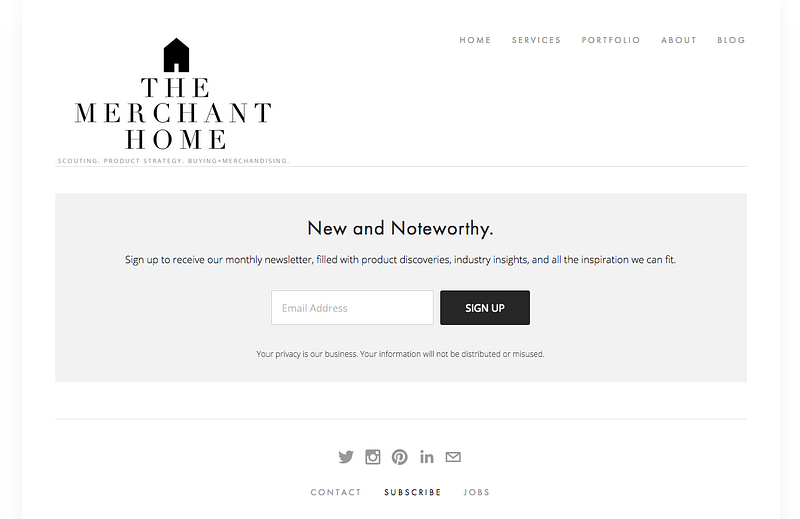
9. Build a landing page exclusively for getting subscribers.

Dedicate a landing page exclusively for signups, like The Merchant Home does here:


10. Before you launch have only a landing page, dedicated to getting subscribers.

Put up a landing page before you launch.Create mystery and intrigue. Invite people to sign up before you’re ready. Use LaunchRock or another service to help you build this.

11. Force people to enter their email address before they get any content.

I don’t personally recommend this (in fact, I typically hate it), but it works for many people. I’d be remiss to not include it in this list. Use sparingly. People might hate you because of it.

12. Add urgency or a deadline.

Tell people what they’ll miss out on if they don’t sign up right now.

13. Host a webinar or a free event.

People love getting free stuff, and we love seeing what’s happening behind the scenes. Set up a free webinar to share what you’re working on (or your “10 best strategies for X”) and have people sign up with an email address to be notified when the webinar launches and when you do similar things in the future.
(Case in point: we’re hosting a free webinar on Growth Hacking on June 3rd, by the way. Join us!)

14. Make the offer really clear. What do they get for subscribing?

Make a compelling offer for what people get by signing up. “Great content” isn’t a compelling offer. What, exactly, are you going to give to them? Why should they spend their precious time with you, and let you into their inbox? Today’s inboxes are analogous to our living rooms. We don’t let just anyone come in. We invite people in that we want to have a conversation with. Why will they let you in?
“Your email inbox is like your living room. You don’t let just anyone in. It’s your online home, and you protect your space.”

15. Give away a free incentive for subscribing.

Make an offer that people can’t refuse. Some of our best signups come from our free offers — some of the experiments we’ve run here at One Month: we did a month of free writing prompts, offered recordings of our best webinars, and currently have a Growth Hacking Crash Course that people can sign up to for free.

16. Get really clear on who you want to connect with.

Why do you want to connect with them? What is their pain point? And why what you have to offer is different, better, and crazy-useful to the people who need it?

17. Add exit intent popups/offers.

Sumo is a great way to add a smart pop-up to your page, and PopUp Ally is also a great tool. An “exit intent” popup only shows up when the reader demonstrates an intent to leave your page (like moving their cursor to close the window or type in a new URL in the browser). You can “capture” people who are leaving with a bright, colorful exit-intent popup like this:


18. Get people to write for you.

Ask people to guest-post and publish with you. A great way to have people share your website is by asking them to contribute to it. Build your audience by utilizing other people’s existing audiences. They’ll share your site when they share links to their work that’s published on your site.

19. Syndicate your content.

Most of the content in the world, wide, web (that big old place) is only seen by a few thousand people, at most. Get your content shared by distributing it broadly. The same piece of content can be used in 10 different places — syndicated as a column, a blog, excerpts on LinkedIn, re-posts on Medium, etc. Content isn’t precious; you can share it in many, many locations.
Put a sign-up link in each of those locations!

20. Guest post, publish, and write for other people’s websites.

The best way to grow your audience is to play off of other people’s audiences that they’ve already built. Submit awesome content to sites that already have medium-to-big-audiences and watch your traffic grow.

21. Write a monthly column not on your own website, but a well-known website.

HuffPo, Forbes, and many other websites are often looking for monthly columnists and contributors. Build your web presence by writing for someone else — and capturing emails with a freebie on your own website.

22. Join social conversations.

Chime in helpfully in conversations and share your knowledge freely. Respond to and upvote other people’s work. This builds trust and reciprocity and people notice it when other people pay attention to them.

23. Use LinkedIn.

LinkedIn has often one of the best referral sources for our content and for business-related sharing. Use it to syndicate your content. Write blog posts on LinkedIn on a different publishing schedule from your regular content release schedule.

24. Go to conferences, online events, and join chats (like Twitter Hashtag chats) to meet more people in your target market.


25. Write an email newsletter.

Give people someething new to read every month, or a round-up of your favorite stuff on the web. You don’t have to write original content to have a compelling newsletter; if you link up the top 10 reads each month related to your subject area, that can be a great read. Email marketing is about connecting with people over email; it’s up to you to figure out what way you’ll use email to fit your businesses needs.
And this brings us back to where we started, which is worth repeating:

26. Write amazing content.

This goes without saying, but can be very hard to do. Give people a reason to read, use, and share your stuff. It’s worth the time — and it’s what builds your audience for the long-term.

How to Settings in Blogger (Blogspot) blogs and websites to be SEO Friendly 2019


SEO is short for Search Engine Optimization. Meaning and significance of SEO optimization is a series of web sites in order to increase the traffic coming in to the web site.

The higher the traffic, the more trusted by Google to be shown on the first page of Google. The more frequently appear on Page One of Google, so the easier the Domain Authority and Page Authority for acquired and upgraded.

The problem is a lot of bloggers who already create blog, instantly making the article. Whereas, before creating the article, you have to set the settings of an existing blog on Blogger.

how to setting blogspot seo

7 ways Setting Settings on Blogger so that Blog SEO Friendly


In setting the Blogger; We will be dealing directly with the (1) Basis; (2.) the posting, commenting, and sharing; (3.) Email; (4.) language and Formatting; (5.) the Search Preferences; (6.); and (7). User Settings.

Each piece had its settings respectively. The following tutorial tips how to settings settings on Blogspot in order for the web site to be SEO Friendly.

1. How the Basic Settings on the Dashboard Blogger/Blogspot


Title:
Has been around since the beginning, since the blog was made; Here is is the name of the Blog itself.
Description:
The place where the blog description of what and how, is available to 500 characters; Please install with a keyword (keyword) that corresponds to the topic of the blog.
Privacy:
Make sure the condition settings Yes on (1) Our Listings; and (2.) Let search engines find your blog.
Blog Address:
The URL address of your blog, and it's not in the dressing. If the change means the same alone to create a blog, and must be registered again to Google, Bing, and Yandex.
Https:
Please enable HTTP redirection features and services to HTTPS when the blogger template support (Note: Recommendations).
The Author Of The Blog:
It is installed under the name + belongs to you; and can invite/add new writers with a limit of 100 people (limit).
Reader Blog:
Just a matter of the reader only, intended for the public or not (Note: should be replaced to the public)

2. how to Setting the posting, comment, and share it on the Dashboard of Blogger/Blogspot


  • How to Settings Blog Posting


Show As Much As Possible:
Articles featured on the main page of the web site; Depending on the taste and look of your theme bloggers used.
The Template Entries:
Leave it blank by default (default)--no need in changes, changed, or else in the dressing.
Show images with Lightbox:
Change Not be Yes. This feature is important if in view, in value, and scrutiny from the SEO Friendly.


  • how to Blog Comment Settings


Site Comments:
Change the settings so Embedded into the comments field appears in the post (User Friendly).
Who can comment on:
Can use the option (1.) users with a Google account, or (2.) Everyone--including the Anonymous in it.
Comment Moderation:
All comments to the blog should be always in moderation to avoid Spam Comments.
Send an Email Request to: Moderation
Enter the email address from your Google account + that in fact as a site owner, do confirm that time also in Inbox sent by Google.
Show Word Verification:
Replace the option Yes to no. If the options are Yes, then it will be difficult for the reader when he wanted to comment on the article (User Friendly). It will be good, select the option Yes.
Message: Comment Form
Just a formality, but it will be good in content with the relevant sentence in accordance with the topic of the blog.


  •  How to Setting Google + Comments


Use Google + comments on this Blog:
Select the option do not (Note: Recommendations are the most preferred).


  •  How to Setting Share to Google +


This blog is associated with your Google profile + your personal:
Select the + does the web site manager.
For new Postings Automatically published to Your Google Profile +:
Select the option Yes.
Remind them to share after the Post:
Please select the option do not because we've set it became Automatic For Yes on above.

  •  How to Email settings on the Dashboard on Blogger/Blogspot


Publish Entries Using Email:
Selected option i.e. disabled.
Email Notification Of Comments:
Enter your Google account email address + blog owner--is closely related to the above comment moderation.
Email Posting To:
There are no options at all, and should be emptied (ignored).

4. How language settings and formatting in the Dashboard Blogger/Blogspot


By default, Blogger Indonesia does not display features and services Revenue in the Blogger dashboard; the goal for the memonetisasi site to Google AdSense.

If you want to register a web site with Google AdSense, then the options are to change the language of American language to Indonesia or the language of the United Kingdom.

Language:
Change language of Indonesia to the United Kingdom (United States)-English (United States).
Turn On Transliteration:
Disabled.
Time Zones:
Select the option for Indonesia Jakarta time,--(GMT + 07:00).
The Format Of The Date: Header
24/09/2018.
The Format Of The Timestamp:
24/09/2018.
Time Stamp Format Comments:
24/09/2018.

For the third date format above must be the same,--should not vary. This is intended to avoid the error at the Google Data Structure.

5. How the Search Preference Settings in the Dashboard Blogger/Blogspot


There is a difference between the Description at the bottom, with the description in the section Search Preferences?

Description in the preferences section of your search will be shown in the Search Engine Result Page (SERP) or page search engines, whereas the Description at the bottom only appear on the pages of the site.

Description:
Only 150 characters, optimize your as good as possible with keywords (keywords) that are relevant to the topic of the site; and its contents should be somewhat similar to the description/at the bottom.
A special message for page not found:
Blogger Themes today is no longer support this feature because in the current era of blogger theme, everything is set in such a way so that it will appear automatically.
Redirects To Special:
Be sure to not use this redirection; a redirection from the old to the new permalink permalink (Not Recommended for SEO).
Google Search Console:
Ignore.
a special robots.txt:
Ignore.
Heading Tag Robot Special:
Ignore.
txt: Custom ads.
Disable memperberat because loading a web site (not recommended, it is not User Friendly).


6. how to Import Settings in the Dashboard Backup & Blogger/Blogspot


In this documentation; you will see the option import content, content backup, and manage videos. Ignore all three of these options.

Delete A Blog? We think not the time to remove the blog.

Furthermore, in the site Feed; change option is full (Full) into Short (Short). For suits (1) The URL of the Feed Posts, Takeover (2.) Footer Feed posts, and (3.) Link title and Link attachments; Please ignore.

Adult Content? If the content or article is not an adult, or not aimed at adults (can be read to the public), then select No.

There is another whose name is the ID Property of Web Analytics, a place where the ID that is provided by Google Analytics to verify a web site that is already registered to Analytics.

7. How User Settings on the Dashboard Settings Blogger/Blogspot


Very easy to do this last point settings. Change user profile settings of Blogger to Google +. Next, select the option Not to Use Draft Blogger.

Next? Is over, and congratulations! You managed it out perfectly:)

All the above settings already applied on the site Add Blogger Themes and our other owned web site. The result is very satisfactory.

That's the tutorial how to blog settings settings in Blogger Dashboard. Got a question because of confused how to settings settings on Blogger so SEO Friendly?


Notification
Ini adalah popup notifikasi.
Done